Showing posts with label pain. Show all posts

30 November 2019

Leadership Activity

Inspired by the conversation of Annie and Roz on the ‘Leadership Quest’ podcast, I went looking for a blog I thought I had written on the subject leadership…. I found nothing, I’d obviously either deleted or merely imagined it. I know I was asked to write one a while back, and I chickened out… the topic is vast. It is so much easier to talk of leadership activity in context than as a theoretical subject I find, because it is complex and far reaching.  So, here is an enthusiastic response to Annie and Roz’s words. This piece repeats many of their ideas, I’ve added of my own thoughts, at random I admit. My thinking has emerged from numerous conversations. Nothing’s new, nothing’s original, the knowledge is ours, and the errors are mine.

There are stereotypes attached to the word ‘leader’ that I think drive our assumptions about who can lead.  The idea of a charismatic individual telling others what to do dominates storytelling across the centuries. Power is is critical, moreover how it is used seems key, there’s an ocean better holding power-over others and sharing power to highlight the injustice others face.  More specifically within the leadership literature, where many authors define their specific type of leadership, concepts can appear hugely individualistic. Presumably this is done by many as a way of qualifying how their interpretation stands as better articulation leadership against thecommon assumptions based on myths. I do think on the whole library holds a great deal of truth, leadership needs to be seen as just, good and moral. Or, rather, demonstrate an understanding of what is accountable, ethical, sustainable, environmental, or seeking greater social justice - leadership is leadership. I made the same mistake 16yrs ago, I though leadership needed to become more equitable, that is oriented to further social justice. The more I read, 100s of texts of a decade, the more I understood that leadership was generally well defined - however in common terms what was criticised for being oppressive was not leadership at all! Confused, let me try and illustrate with a few perspectives. Not an exhaustive list, I’m going for fast-and-furious, not structured-and-precise. In my enthusiasm I’ll no doubt stumble. The following points, in no particular order, rose to consciousness as I listened to Ros. 

·      Language. I say ‘Leadership Activity’, because I find using the word ‘leader’ does little to articulate leadership as action, possibly shared. Given opportunity and strength activity is a choice to move, not a personal characteristic.
·      Leadership activity is not a position or a title. I find that having to put ‘leadership activity’ in a sentence stops the talk of me-leader / you-follower; it speaks to power-with not power-over.
·      Context. Place is critical. As I watch images of London Bridge, it is the individuals who step up, step in and run towards what’s needed that make a difference.
·      What – not who.  Sometimes it is about physical strength or specialist knowledge. Some situations aren’t improved by a meeting. “Can anyone fly an aircraft perchance? Please form a queue and we’ll weigh up options”. Thankfully for democracy to emerge, leadership activity necessitates conversation, and certainly coproduction delivers on transformation. For alternative ideas to emerge, diversity and divergence help, turning away from improvement and to illuminate new horizons.
·      Unthinking. Assumptions, sadly, beliefs not thoughts, lead our hands before our heads make the story. Sadly before our minds can reflect on meaning hidden beyond view, we act on stereotypes that draw heavily on myths and often falsehoods. Mindful determination is needed to interrupt a belief in the charismatic, loud, aggressive winners that inhabit our hearts – the tall tales that cloud our heads. It takes energy, slow-thinking, to consider the quiet, inquisitive, wise, learned and joyful people engaged in a shared movement for a better world. In a hurry, in a panic, or with anger, the chances are we’ll be robbed of the strength to challenge existing tales. [I don’t wonder how the bullies get in]. Evidence suggest people are swayed by feelings, not arguments, and our perception tends to discredit any information that is at odds with what’s in our hearts. Evidence suggest we will find a variety of imaginative way to re-tell stories from our experience, and to view the decisions we make as objective. 
·      Education! You wouldn’t ask a person to be an optometrist because they’re wearing glasses. Yet we dismiss people because they have the wrong status, physique, language or look. As any other activity, leadership action is best when underpinned by knowledge. We need to do our homework. We’re back to the 10 000 hours and 800+ texts. I’m always amazed that so many books on leadership are written in the first person; with no evidence, no background, no community, and no shared thinking. To miss-quote John Maxwell; “if you think you are leading without looking behind you, it’s nothing but a walk in the park”. If the one in front taking advantage of the privilege does not acknowledge others, that’s not leadership. It is not about character, it’s about understanding, that’s why we need to hear all perspectives. References or citations aren’t an affectation imho, they are an acknowledgment of joint endeavour – on the shoulders of others.
·      People. Leadership activity benefits from community, more specifically a network of connection and shared interest! Attacking a problem often gets little achieved; as fighting bad doesn’t ensure good.  Imagining a better world has benefits that go way beyond beneficial gains in the short term.
·      Together. Yes it is about power, but it’s about using it wisely, sharing it, trusting other individuals, and defending rights and the empowerment of groups often silences. It is about shouting beside those who are seldom heard. 
·      Accountability and legitimacy: Knowing who’s missing!! An activist attitude certainly keeps action on the disadvantage. Leadership activity needs to respond to injustice, articulating its anti-sexist, anti-racist, anti-homophobic or ant-ableist intent. Speaking the name of injustice helps us work to increase power for good. If we don’t stand against unearned privilege existing myths will not be challenged. 
·      Values! Not value. We don’t have to have the same values to respect each other’s. The list may be extensive, but not infinite. I think it’s important that action has strategic intent, and price does little to determine its worth. If we are too busy, stretched, broke to have a conversation about sustainability the damage is probably far worse than we can say. [wrong forest!]
·   Stop!? It’s a question I ask in training.  Where Institutions continue to deepen inequality, by getting better at delivering on inequality, its working practice and its culture obscures the discrimination it perpetuates. In an age of imposed insecurity, driven by a belief in scarcity and deficit. What can we stop doing? Time and energy gained could be better spent, surely? 

A moral imperative is needed to develop Leadership activity, which requires both the ability to think in a hopeful way about possibility and a determination to act on what is positive. This requires an ability to articulate both great vision and daily activity as congruent movement. Reality will alter evolving vision if change facilitates re-imagining in the process. Leadership activity can be shared, but no doubt a more difficult choice for those most oppressed by isms touched on above. As my friend John taught me, leadership activity is to put principles into practice: the abstract to the concrete and the inspirational into the actual experience. 

Leadership activity demands an ability to be authentic in words and true in deed. That means saying sorry, because it’s hard, and mistakes happen. It is hard to walk power-with, and to act in ways that empower those around us. Helping others to believe in their ability to  change their own world, and their ability to live their best lives. 

I’m sorry to say that for too many years I only understood leadership as an autocratic or bureaucratic position of power, an immediate response by an overpowering voice with more qualifications and status than trust in a collective strength to change the world. I was a little too keen to be admitted to an elitist club – one I assumed would give me authority and power-over. Ironically, I was angry because I believed I had the right to join in, but felt I would not be accepted, let alone treated as an equal. I now realise why my feelings were deeply contradictory, how my own learning has changed my own definition, and the increasing tension with public notions of the conquering-hero over the kind and wise.

It’s infuriating, but I found the other blog as I finished writing this one: it’s a myth

Leadership blogs are like buses, you don’t see one for ages…


It’s a wrap!! 


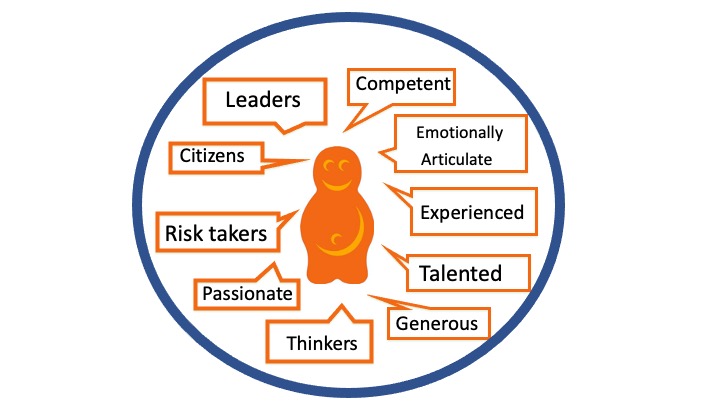
My leadership team today:
Ahmed, S. (2017). Living a Feminist Life [Kindle Edition] . Duke University Press.
Block, P. (2008). Community: The structure of belonging. San Francisco: Berret-Koehler.
Block, P. (2013). Stewardship. Chicago: Berrett-Koehler.
Brown, B. (2012). Dearing greatly: How the courage to be vulnerable transforms the way we live, love, parent, and lead. London: Pengiun Books Ltd.
Daniel Goleman, R. B. (2004). Primal Leadership. Harvard Business School Press.
Denning, S. (2005). The leader's guide to storytelling, Mastering the art and discipline of business naratives. San Francisco: Jossey-Bass.
Gladwell, M. (2008). Blink - The Power of Thinking Without Thinking. London: Penguin Books.
Helgesen, S. (1995). The Female Advantage, Woman’s Ways of Leadership. New York:: Doubleday .
Holbeche, L. (1999). Aligning Human Resources and Business Strategy. London: Butterworth-Heinemann.
Kahane, A. (2010). Power and Love; A Theory and Practice of Social Change. San Francisco: Berrett-Koehler.
Kahneman, D. (2011). Thinking, Fast and Slow [Kindle edition]. London: Penguin.
Lawson, I. (1999). Leaders for Tomorrow’s Society. London: The Industrial Society.
Lukes, S. (2005). Power: A Radical View. Palgrave McMillan.
McKnight, J., & Block, P. (2010). The Abundant Community, Awakening the Power of Families and Neighborhood. San Fransisco: Berret-Koehler Publishers.
Senge, P. (2006). The Fifth Discipline, The art & practice of the learning organisation. London: Random House.
Sennet, R. (2003). Respect, the formation of character in an age of inquality [Kindle edition]. London: Pengiun group.
Sergiovanni, T. (1985). Landscapes, mindscapes, and reflective practice in supervision. Journal of curculum and seprevision , No 1.5-17 5.
Thompson, N. (2007). Power and Empowerment. Lyme Regis: Russell House Publishing.
Zeldin, T. (1998). Conversation, How Talk Can Change Your Life. London: The Havilland Press.


23 March 2019

Brooding of Bradford.....

....  oh to live in Preston!


Dear BBC

I have been a license payer for more moons than care to remember, so I feel upset that I need to ‘put pen to paper’.  In the space of 24hrs I have heard not one, but two, uses of language on BBC airways that I find highly problematic. To hear M* and N* used on prime time shows were chilling moments, because in the safety of my own car and at my own breakfast table, I felt mocked, shamed and insulted. Many will no doubt argue that words don’t break bones, I think they legitimise greater abuse.  I wonder how many were teased in the workplace or shamed in playground as a result of sloppy, mean and careless wording. Let’s face it, if the woman or man on the radio can say ... the words used are to be spoken without hesitation. I wonder how many of us sat by our radios stunned and hurt, waiting for an apology ... it never came. 

My beef though isn’t with the individuals involved, I’m hoping they are sufficiently mortified. Yes, I’ve been there!   I am not on some kind of political correctness vendetta either. My issue is with the Corporation, and with what I consider a failure to give their employees the adequate information to keep their audiences safe from the power they hold as speakers. The words are not to blame, they are neither bad or wrong, it’s the meaning behind them that needs care, their association to pain therefore requires airing.  Calling people names is petty at best. But labelling has helped paid professionals lock people up. Ridiculing people with all types of impairments has made dehumanising and shaming ideas so common place they are not noticed. For many the M word is synonymous with people being denied freedom, as stated in law under the Mental Deficiency Act, a piece of legislation that led to people’s detention in often atrocious, inhuman and painful ways. As for N*, most people to have left it in the playground... where it does not belong either!!  If individuals wish to use it behind closed doors, well shame on them, it’s not a crime - but it'll teach others to be unkind. In public, however, specific terms can make people with all types of impairments feel victimised, pushed out and ashamed. Childishness doesn’t soften the blow, I feel it makes it worse. Radio is an intimate medium, hearing the rejection of one’s humanity over breakfast did not put me in a good frame of mind for a day in the board room. [Apologies owed!]  As disabled person I felt treated as an object of derision, rubbished if you like. clearly, my contribution to society is not worthy of consideration. Sadly, it took me right back to being kicked in the corridors and having my head flushed in the toilets at school. 

Surely it is the Corporation’s responsibility to ensure that every single individual in its audience is treated with respect. That means knowing what harms those in specific groups, under the law, see the Equalities Act for characteristics of 9 groups. People who identify as members of marginalised groups have equal right to feel safe to switch on - radio, tv, and internet. Disabled people have been recognised as a group entitled to specific attention since 1999 by The Disability Discrimination Act. Ignorance is no longer defence here, and I would argue that the introduction to Disability Equality has been a route to helping many understand an entitlement to parity for the disabled population. I think at the very least the education in the workplace helps prevent attacks - though obviously not over the breakfast table or in the car. It says volumes about the culture of the BBC that bullying and degrading language goes unnoticed. Broadcasters seem to feel it is ok walk into other people’s lives, and carry their ignorance unashamedly and use words with casual disregard. Maybe we, the denigrated and mocked, need to withdraw our support in more interesting ways… 

I don’t think I’m being a disgruntled-of-Tonbridge here. I am proper disgusted that there are far bigger crimes in the world. Wars, epidemics and poverty driven by global inequality. I am scandalised that people who are locked up, have their heads kicked in, and die without institutional accountability or national outrage. In a country that can’t afford to support its most disadvantaged citizens, successive governments prioritise spending on growth and kind regard for what greater wealth can buy. While it appears we live in a world that cannot afford to extend an entitlement to social justice or well-being to all beings equitably. These things offend and disgust me in the extreme. HOWEVER, I think, there is a disrespect that is often left unchallenged as a thinner end of a far more lethal cultural wedge. One that helps to justify the freedom of people in privileged positions, paid generously to speak publicly across the globe, to express their disregard for those possibly facing far more pain and hardship than they’ll ever have to know? 


* I have removed the actual words in this text, as a this now blog it stands in the public domain. I think the actual words can easily be inserting by the reader, or even replaced by others, ruder or more explicit. The words will be used in private communication, whilst unfortunate, those getting this as a letter will need to identify those involved and expressions used. My intention is not to pick on individual, messaging them or pointing them out directly, but to raise issues of institutional and organisational accountability more generally from a position of professional wisdom and vague academic insight. 

02 December 2018

Celebrating economic contribution #IDPD2018 #PurpleLightUp

I love working!! It’s a rare pleasure these days. Despite the effort...

I particularly love facilitating Disability Equality Training. It’s become a source of pride, honour and huge enjoyment.  In an effort to celebrate #purplelightup I thought I would list a few joys of the job:

  • I love that people enjoy thinking about words. Not political correctness, good or bad words, but the thinking that provides a diversity of ways to articulate the position of disabled people in the world.
  • I love that when asked to list stereotypes people initially find it difficult, but move on fast to pages full of examples. This just proves to me how many negative ideas there actually in our culture - the toxic soup in which we steep. 
  • I love that when asked people can very quickly tell how they’d feel, and how they’d act if they felt those stereotypes related to them. The room invariably fills with an unpleasant feeling, making us all uncomfortable, and sadly for which we have only ourselves to blame. 
  • I love that at that point I can exclame -with a certain amount of glee: "see we’ve created dis/ableism!!!! Did anyone mention impairment in the last 40 minutes?!?”  <boom>
  • I love that when asked, and admittedly with a little resistance, people can typically make a list of things they can do to address the cultural and societal injustice they’ve identified in the session. 
  • I love that people often come to Disability Equality Training thinking they’ve nothing to gain when they leave overwhelmed by the amount they have too take away. 
  • I love that disability equality gives disabled people a voice, which added to an individual perspective, enables enfranchisement, power and strength of shared interest and a vision.

I am blessed to spend days at work revealing information others can use as a authoritative knowledge base. It’s taken years, but the blend of personal experience, academic evidence and professional wisdom ensures a kind but robust approach to disability equality ! 


Thank you to all participants. Without you I’d look a turnip sat with a PowerPoint on my own! 🤣


01 October 2018

Trust and movement at the Scottish Government Networks Conference

It’s a huge honour to open a conference, but one that comes with a degree of fear. As the first speaker you have nobody to follow. Following others speaks to the heart of trust. Trust is my touchstone today.  In the absence of another’s footsteps I’ll need to trust my own direction for the next short while.

I’m a paid pest! Well a pest anyway! I have spent a number of decades now delivering disability equality, and working on research relating to disability, accountability, Human Rights and emancipation.  [Everyone needs a hobby!]. As a pest I shake things up, this means I disrupt conversations - sometimes just by being in the room. More than that I’m an activist, I specifically question those conversations that present disability as a deficit, a problem attached to an individual, and an illness to be cured. When I became an activist I chose to step away from viewing disability solely as the personal experience of impairment. I needed more, so reached for what I now understand as research evidence and movement politics. Together these elements of evidence based knowledge came together to complete a view of disability that many call ableism - a social oppression.

It was not a choice that was straightforward, it took years, and the trip was fraught, the journey torturous. Along the way I came across the Four Thought podcast of Alan Bissett, talking about his awakening to feminism as the contradiction he sought to his growing addiction to porn. In the programme he talks about the difference between identity and politics, and he explains how he now sees feminists as an united group with shared and diverse interest. For him feminisms were important to his understanding sexism. In much the same way as the Social Model of disability, for me, represents an extensive list of interests disabled people may share.

Bissett's view of feminism was more than one that linked identity to women's personal experience, it was about a shared history and many ideas. Most importantly, he had to put his trust in women's voices to help him change his thinking radically. He saw this as a choice - a right to stand in opposition to the oppression that is sexism.

The trust we place in others is critical to our networks, if we are to move from ‘me’ to ‘we’.  Having an impairment is only a small part of our own tale, a critical part undoubtedly, but the pursuit of shared interests makes us more powerful in a joint storytelling. As in other civil rights movements, there have been many activists, thinkers, movers and shakers in a disabled people’s voice. What I think defines us as an anti-ableists is shared struggle for Human Rights set against vast structural and societal inequalities.

Personal experience is part of the understanding that drives my work, but so does a shared knowledge of disability equality and much research evidence that informs a whole manner of things relating to the interests of the disabled population. Explaining how these ideas intersect is beyond my ability here - I trust you’re getting a picture! For me, the idea of being part of a network is about belonging to a much bigger crowd. There are many ways to be disruptive: trailblazers, radicals, politicos, unionists, activists, educators,  policy-makers, all sorts... librarians!  The power and strength I’ve gained from moving with the crowd is huge. I feel stronger and less vulnerable knowing I am one of many. It is also energising knowing I am part of a storytelling that has a history, many voices and hundreds of ideas. Some I may disagree with, but all are anchors on turbulent seas.


The trust I gain from being part of a network, a movement, has offered a home, a language and a sense of belonging. Our shared stories are a growing library, an evolving tale of endurance in a disruption that weakens injustice!

Thank you to everyone that made this a fantastic event.

07 December 2017

So Hammond we’re unproductive are we!?

Again this week I interrupt my excellent work to fume!!

I think my great grandmother would have called you a ninny Philip Hammond. I have no words clean enough for public view!  To put it another way, let me take a quote out of context, your comments ‘take ignorance to a whole new level!’.

Before we talk about productive, let me tell you how I hard it is to even get work:

I got through school.  Yet, not that long ago people like me were denied an education. A trend that’s making a come back it seems. My mother fought a huge battle to get me into school. I sat in some classes admiring the gardens beyond, as many teachers made it clear their job was neither to include me in activities, nor to mark my work. Bullied and abused I still could learn, but some teachers thought they were not paid to see beyond the targets I couldn't meet. Despite this I sat exams, although many said this was pointless. In the eyes of a few I had nowhere to go, no intelligence speak of, no skills, no future. I passed... but for what.

I want myself employable!  I had applied lots, lots and lots. Rejections. lots. I hadn’t the right qualifications, I got more, still not enough experience etc.. an unusual CV.   Tell you what, why don't you give us your time for free!   Whatever…! Apparently it’s not unlawful to discriminate before you have a job; and it’s fine to make up costs and/or blame the market, the board or the economy. We hire those with money, not those needing it most. Believing our own prejudice is easier than looking at the flaws in the system, or the society beyond it.

Safety and security?? Let’s find a house... would be good. But no. There are so few houses, many far too expensive, elusive is the accessible home. Private landlords can refuse. Estate agents are for the most part unprepared and ill equipped.  Once inside, moving around can be difficult, getting meals a nightmare and sleep often impossible... pain, drugs, fear all have a cost.  There’s help... but not for what you need. Most rely on those closest, huge pressures. For many breakfast, shower and dressing are on other people’s terms. For some it means getting up early enough to take medication. Medicine that leaves you feeling sick, hazy and nauseous, you need time to get upright, coffeed and smile. it's expected, de rigeur!

Transport?? Again a lottery, some trains/buses are accessible, others not. Some drivers will not stop, others will say their ramp is broken, or it’s the support workers day off.  For others it might be a car, but good luck with parking, never a given... 4 times round the block you go.

On the job, attitudes vary, some people really understand that what you bring is unique. But for others it is assumptions based on the stories they’ve heard about scroungers and good for nothings. You have to prove your worth, contradict the expected. Put up with rubbish, people asking rude questions, assuming failure, dismissing what you have done well as fluke.  Expect the finger to be pointed at mistakes, the questioning of professional experience, baby talk and wagging heads... it can be a grueling day. 

You leave work, tired, hungry, humiliated and depressed. Drink and chat, possibly not, no parking or access, twice round block ... give up. Small glimmer of hope, till you see a car on pavement so you can’t get in...

Shopping? Not tonight, accessible bays taken, so nothing fresh this evening or any milk for breakfast.
Getting home, always a gamble... friendly neighbours on one side, but others are loose cannons... key in police number as you near the property just in case.  You’ve asked nicely, but you were then threatened, so fear rises as bile seeps into your throat. Thankfully someone is home, so rescue is at hand. Otherwise, it is again round the block we go...

But of course it’s my fault!! Clearly! Pin the lack of effort on me why don’t you Hammond?  Hoping for equity and accountability in the shape of legislation- what was I thinking!!!

Enough piffle there's a thesis to finish.....

28 February 2016

Impairment and disability: a world of difference

The d/Deaf and Disabled People's movement in the UK has used the term disabled for many years. Many use it to make clear that it is the disablism and ableism disabled people face that qualifies them as disabled. As a group, a population world wide, we are disadvantaged by a characteristic oppression - ableism - and therefore its is our communities that have a problem. Not us. The disadvantage imposed on the disabled population comes through environment and culture. while personal difficulty shouldn't be minimised, its more complicated than personal difference or isolated issues. Yet, because impairment and disability are often used interchangeably, disability is mostly understood as synonymous to the personal characteristic, cognitive functioning or physical deficit of the individual.  The following applies disability theory to language. Often referred to in Disability Studies as the Medical Model and Social Model, I use it to framing language as practice - a personal super-power in public spaces.

 
The Social Model as self-referenced language 

As a shorthand, in disability equality, the Social Model refers to the shared understanding, and activism, of politically committed disabled individuals, and their allies,  in working to redress the impact of ableism in policy and practice.  Please appreciate not all disabled people agree, like those within the feminist movement there are radicals, moderates and non-subscribers! However, particularly for those working in the public spheres (writers, campaigners, educators, activists), they use of specific ideas to convey the empowerment of the disabled population. 

As part of my Ph.D research, I read over 900 journal abstracts on “disability”. I then used a blend of personal experience, research evidence and professional wisdom, in my analysis. I found that I could feel - to a growing extent - whether the articles I read honoured the voice of disabled people by aligning to the interests of the Disabled people's movement. Even where I felt authors struggled with words, reading under them, I saw meaning that was the voice of an ‘ally’. In this blog I use older ideas related my work on dialogue to help share a few ideas about the language used to discuss matters of disability. 

Although, five different types of dialogue have been identified, I've grouped them here into two categories for ease: public and private.  When I talk about disability I first consider whether my conversation is for general broadcast or personal interest. I can then more easily differentiate between what I feel the world needs to hear - disablism; or whether it is a private conversation in which I need to respect the privacy of lived experience and/or personal predicament. So for example, I'll talk about disabling barriers in training, however privately I'll talk with a known person or group about the experience of living with depression. These aren't hard and fast rules, or definitive categories. Equally, the boundaries are not clearly defined, but on the whole it's a rule of thumb that's as good as any.

For many the term ‘disabled’ has become positive and empowering, as it denotes the recognition of oppression and affiliation to a civil rights movement. Used as a verb - I am disabled by attitudes; he is disabled by systems, he faces disabling structures - it recognises disability as a social oppression - something external to the person. Significantly, it also acknowledges something that can be changed to further inclusion – through the inclusive practice of acknowledging and removing barriers.

Some people hold the view that ‘Disability’ is not a description of a personal characteristic. A disabled person is not a ‘person with a disability’ as the person does not own the disability in the way that you might be ‘a person with brown hair’. Consequently, some people understand that the opposite of ‘disabled’ is not ‘able-bodied’ or ‘abled’, but ‘non-disabled’ or ‘privileged'.  So for these people the use the word ‘disability’ describes the social reaction to difference. Disability is not banned or bad, but ‘impairment’ is used more mindfully to talk about medical conditions,  diagnosis or description of functioning where it is required – probably privately or with anonymity.  


Extending terminology about disability will help us all to talk with more certainty about:


- the disabled person - their skills, experience, qualifications and particular knowledge

-  disablism -  the barriers, negative attitudes and working practices faced by disabled people but not by their non-disabled colleagues within organisations, sectors or professions (eg fear, lack of awareness, avoidance, micro-aggression, stairs, complex or incomplete policies)

-     ableism – the misrepresentation or silencing in text; the documents, communications, accounts and wider storytelling of the organisation.

 -  impairment, condition, difference or functioning – private information, the disclosure of which is a disabled individual’s choice to disclose: the same is true for their identity as a disabled person

-   inclusive practice - an ongoing process of adjusting equitably to diversity.


It is all very good news, as addressing the prejudice, discrimination and inequality disabled workers face makes our world.

Understanding the critical difference between different terms allows the speaker/writer a choice to talk separately and clearly about:
·      a named individual => the person => bob
·      impairment => functioning => difference
·      disablism => institutional discrimination => structural barriers   
.      ableism =>  society’s inequality and injustice  => oppression

Some love the simplicity of these examples: 


Examples of
Impairment

Quadriplegia
Polio
Cerebral palsy
Blindness
Depression
Deafness

Examples of
disablism 

Buildings without ramps
Poor health provision
Bullying, name-calling
Segregated education
Workplaces without lifts

Disablism can be likened to racism, sexism, homophobia…. In the most simplistic way, one could say that the disabling effects of our culture is imposed on  disabled people. Their cumulative weight may be in addition to the pain, effort or predicament that may be caused by a disabled individual's difference. However, in the public sphere, everyone can do something about tackling disablism, whether we have an impairment or not. Allies, to my mind, denotes those who acknowledge the ideas of the Deaf and Disabled people's movement, D/deaf and Disabled People’s Organisations, and those keen to acknowledge the voice of disabled people who as a group have be silenced throughout the years. I often return to my introduction to an earlier definition: "Disability... the disadvantage or restriction of activity caused by contemporary social organisation which takes little or no account of people who have physical impairments and thus excludes them from the mainstream of social activities". (Union of the Physically Impaired Against Segregation, 1976). Not because it's perfect, but because it began a conversation that changed meaning not just words.

 Using disability to mean impairment denies the complexity of both individual experiences AND  cultural injustice. The negative of unhelpful ideas relating to care and cure can do damage, when words often used in the media describe the lives of disabled people as worthless or incomplete. The way I read it there is so much confusion around terminology that sometimes we are too scared to talk about issues that affect us all.  Power is still in the hands of professionals, with  many non-disabled - doctors, educationalists and social workers - still insist on using politically correct - rather than appropriate - terminology. Research suggests political correctness  confuses issues, advocating terms such as physically challenged, visually challenged etc.  Such expressions detract from the real issue: who is being challenged here? Disabled people certainly do feel challenged by other people’s lack of tolerance and by the barriers that make it harder for them to participate. 

The nub of the issue does not concern ‘good’ or ‘bad’ words. Respectful language need not be either negative nor positive, in my opinion, it does needs to articulate an understanding of the oppression disabled people face - ableism - with enough clarity to make courageous conversations possible.