Showing posts with label accountability. Show all posts

03 December 2025

International day of Disabled People


Celebrating Disabled People’s Creativity, Experience and Voices on the International Day of Disabled People


Pools and Prejudice: Death in the Shallows

On this International Day of Disabled People, there’s no better time to celebrate stories that challenge expectations, confront prejudice, and centre disabled lives with honesty and strength. That’s why I wrote Pools and Prejudice: Death in the Shallows— I hoped to balance tension, wit, and social commentary with rare precision.


If you’re looking for a book that will both grip you and make you think differently about the world, Pools and Prejudice: Death in the Shallows is exactly that. Today, we celebrate disabled creativity, disabled resilience, disabled truth-telling. 


I wanted the plot to shine a light on the realities of disabled people navigating a world that often refuses to see us clearly. 


The story follows Meg whose experiences of exclusion, institutional failure and everyday ableism are woven through a mystery that unfolds in and around a local swimming pool—a community space that becomes a microcosm of society’s attitudes towards disabled people.

I refused to soften the truth, and avoided speaking in metaphors or inspirational clichés. Instead, to give readers a narrative grounded in lived experience and disability equality: flawed systems, hidden hierarchies, the exhausting bureaucracy disabled people face, and the emotional resilience required simply to exist within them. And also hoped to capture the warmth, humour, friendship, and the small acts of solidarity that keep people going. 


Readers say: 


“Characters bring texture, complexity and humanity, each revealing different sides of disability, trust and belonging.

Pools and Prejudice is more than a mystery; it’s a challenge to look deeper—beneath the surface of institutions, beneath polite conversations, and beneath assumptions about what disabled lives should look like. It’s bold, unapologetic storytelling from a disabled writer who understands that representation is not a luxury but a necessity.”


On days like today, when the world pauses to recognise disabled people, their rights and their contributions, it reminds us why authentic stories matter. They expose injustice. They provoke conversation. They forge connection. And, importantly, they carve space for disabled people to be protagonists in their own narratives—complex, fierce, and fully realised.


Furthermore in order to respect Disabled People’s Identity and highlight Stereotypes, I was careful not to counter the negative stereotypes imposed on disabled people with equally toxic positive ones.


https://www.amazon.co.uk/dp/B0DLBHGBLX

29 January 2025

How Often Do You Have Sex?


Now that I have your attention, let’s talk about narratives: How We Tell Tales


Think about narratives—the different types of conversations we have every day. Many of us change tone and wording without thinking. The way we speak changes depending on where we are and who we’re speaking to. You wouldn’t talk to your boss the way you talk to your best friend. You wouldn’t approach a stranger and immediately ask them about their intimate life. And yet, when it comes to disabled people, this social toggling or its sensitivity seems to disappear.


 If asked how often I have sex, I would expect the very close friend to have at least filled my glass a few times!


Old lady’s dry gin


Public Narratives


Pick up a newspaper, and you will notice how journalists shape narratives to guide the reader’s focus. Consider a headline: George, 56, fell in the street because of a pothole. Why mention his age? Unless he is 5¾, George will be unlikely to want you to know his birthdate! Age is personal. A journalist will mention it because it jars—the wrong toggle invites a particular reaction. We identify with George if we're around his age; perhaps we’ll feel sympathy, concern, or a reminder of our own vulnerabilities. Journalism is about framing, about making certain details stand out while others fade into the background.


Similarly, if a journalist writes about sex in a professional context—say, a dentist having a relationship with a client—it’s because they hope their readers find it surprising. The narrative assumes that the mix of workplace culture and intimacy is unusual. In this case, there’s nothing to report. What dentists do in private is personal, as long as everyone consents. (Jill and John got married and lived happily ever after 🙂)


Misplaced Focus on Medical Matters


Getting the focus wrong—the toggling—often happens, sometimes unwittingly, when disability is written about. While many disabled people see themselves as human, the narratives about them often articulate a faulty, medicalised view. Reading about disability in mainstream literature, you’d be forgiven for thinking that most disabled people constantly need medical help. This framing can make disabled people seem less human, focusing only on their differences, often medical conditions. The narrative subtly shifts; the George headline becomes Autistic Falls in the Road.*


This brings me to a recent exchange in the supermarket. As I picked up a lettuce, I never expected to be asked about my condition(s). Not because I’m ashamed, but because it’s personal—jarring. Yet, I was asked what was wrong with me by a stranger. Sadly, it happens too often for me to ignore. Typically, in public, we don’t ask strangers deeply personal questions.


After ten years of study and research, I’m not surprised that disabled people are frequently subjected to intrusive questions: Are you taking medication? What’s your condition? Does your disability allow you to do this? These questions wouldn’t be acceptable to most typical social interactions, so why do they become acceptable when directed at people who appear disabled?


Literature and Personal Truths


Different literary genres use distinct storytelling methods. Mysteries, for instance, focus on action and facts, leading the reader in a straight line to solve the puzzle. Memoirs, on the other hand, rely on personal truths and emotional details, asking the reader to see the world from the writer’s unique perspective. As Mary Karr puts it in The Art of Memoir: “Truth works a tripwire that permits the book to explode into being.” So why tell tales about disabled people? Needy, lazy, broken, sick...


Disabled writers and scholars have pointed out that narratives about disability often follow a script that doesn’t align with their actual lived experiences. The focus tends to be on medical conditions rather than the person as a whole. This mirrors real-life interactions, where people feel comfortable asking disabled individuals personal questions of a clinical nature they wouldn’t ask anyone else   (Medical Model )


It’s not the same, but the equivalent of walking up to a stranger and asking, How often do you have sex?


So, the next time you meet someone, think about how you frame your questions. Do they reflect genuine curiosity about the person? Cats, curry, chardonnay? Or are they shaped by a narrative you’ve not challenged? Let’s move beyond the jarring stereotypes and towards conversations that recognise all people as complex individuals.


*totally disrespectful I'll agree! 


08 May 2024

Underpaid - if paid at all

Worth?! An Ongoing Bugbear


I've got something I need to get off my chest today. It's an issue that's been bugging me for quite some time now – the unfair judgment of someone's worth based on their disability. Let me paint you a little picture.


Imagine this scenario: you've just returned from a lovely holiday, bags unpacked, and you go to toss that first load of laundry in the wash...only to find your washing machine has decided to quit on you. Disaster! With a soggy mess on your hands, you call up a trusted plumber to come and save the day. A few hours later, Mr. P arrives, does his thing, and just like magic, your laundry crisis is averted. Did you stop to question his skills or the fee he charged? Of course not! You took it on faith that this professional had the proper training, years of experience under his tool belt, and the know-how to get the job done right.  


Now, let's add a twist – what if Mr. P was disabled? Would you have then started haggling over his fee, assuming he was somehow less qualified for the job? I'd certainly hope not! Yet, this is the kind of nonsense that the disabled population so often face.


I remember when I was just starting as a trainer, I was being paid 40% less than my non-disabled colleagues...all because some people didn't see me as "qualified enough." As if the way I moved or spoke somehow negated years of education and real-world experience! Even a decade into my career, clients would expect a discount. It was interesting that having delivered Equality & Diversity, and leadership training to one particular organisation, they asked for a lower price for the disability equality training session. Furthermore, I was asked to give it half the time, and it was abysmally attended.


The assumptions don't stop there, either. There's this bizarre notion that just because we have a difference, the only expertise we could possibly have as Disabled people is in disability. It's like assuming someone who wears glasses must be an ophthalmologist! Um, no...just like anyone else, we have a wide range of experience, knowledge and skills. My abilities and interests go far beyond identity or physique! 


Here comes the real stinger! You would be amazed how many people have asked me to work for free! That’s right. Having failed the interview, and faced the ableism of interviewers. “Surely, you don't need to work… I don't believe your CV… you have the wrong skills…” etc. I often get an invitation to do countless hours of volunteering instead. Literally asking me to pay in time, effort and money for own employment. My last volunteer job cost £140, a sum I had to find.


On top of being insulting, being treated as worthless is also incredibly painful. How many opportunities have I missed out on simply because someone decided I'd be "better off" sticking to a volunteering or disability-related role? Unfortunately, for many years, I didn't think to question such narrow-minded thinking. I accepted that I should specialise in disability because it was expected of me. Needless say I did eventually get my head around a socially pervasive and complex subject. These days, I know better even if I can fight it. With a master's degree, a PhD, and decades of valuable experience under my belt, at least I know who is undervaluing my worth. I may move, speak, or think a little differently owing to unusual experiences, but that certainly doesn't make me less talented or knowledgeable in the field. At the end of the day, disabled or not, we're all just human beings doing our best.


So let's start giving each other a fair shake (it's a gift) shall we? Our quirks don't define our abilities, the lines aren't straight on human development. I'd trust myself or any other disabled person to unclog your metaphorical pipes just as well as the next plumber!

11 March 2022

Are my words safe in your mouth?

 Billy – age 4 “When someone loves you, the way they say your name is different. You just know that your name is safe in their mouth.” 


I don’t know who Billy is, but I’m guessing he’s no longer 4. But he nailed it. I hope I can do him justice in the following, that his words are indeed safe in my writing. I was reminded of this quote, while I was polishing my literature review months back, think Forth Rail bridge ...  Then last week I had some work stolen and it’s upset me - possibly more than it should.  I received an email asking me to agree to corrections made to a training handout of mine. It is  a little ridiculous I know! Had I been approached first, I would have shared recent happily. But I was left feeling attacked.  Since then I have had a number of conversations about reference and citation, clearly some people struggle to see the wrong in paraphrasing or copying without mentioning authors’ names.  


When I am referencing I am foremost keen to demonstrate the privilege it is to quote someone’s hard work. I take care to articulate their understanding, to pass on their ideas, and to respect their words. I always feel a sense of trepidation. I just hope that my struggle with the written word never makes another’s ideas seem different to what they meant, that their work is safe under my 'pen'. The numbers involved fill me with fear, (678, p. 70), as getting them wrong would suggest carelessness - when in my case it could be ham-fistedness not ill intent. There’s an ocean of difference, I think, between misspelling or interposing numbers and wilfully denying where an idea was found. Who said it, when?


Ahmed talks about her library of female writers as a source of strength (Ahmed, 2017). Equally, I refer to a library in my own work. I purposely look for authors who identify, show an understanding of their field or have a perspective/sensitivity aligned to the topics they write about. Black writers, that identify as anti-racist and use a critical race perspective, for example. I do not always agree with every word written, but I’ll try and convey my understanding of the cultural context and the fight for certain ideas at the time of writing. In terms of disability rights, what disabled people fought for in the 1970s will not match today’s struggle, but I would still take care to understand their perspective, rather than dismiss ideas we have been able to build on since. Opposing professional power may seem less radical today than the nuanced conversations about ableism. But the departure from established narratives they have come to inform later was seismic, because it's harder to oppose established ideas that to add to an evolving way of thinking. 


Together writers on a topic tell of the development of an emerging story, not the right or wrong of any point within its storytelling.  Like Ahmed I find power in being able to refer to members of a tribe, my gang, particularly when trying to articulate where I found strength in shared direction. Over the years, reading the work of others, has been about adding depth and breadth to my own knowledge. So referencing comes with high degrees of care, I am mindful that the writers I quote have no doubt spent days choosing one word rather than another. I do not wish to paraphrase, or missquote, writing out of context in a way that would alter meaning. I’ve come across this, thankfully rarely- it stinks!


With practice I’ve become more able to think about the possible identity, perspective and  professional context in which writers write. What are they seeking to convey overall, what do they care about, and maybe what they are fighting for or against. The brackets, name, and numbers, are ultimately about celebrating another person’s hard  work. Respecting their vision, feelings and thoughts - motivation and passion that shines through text. Sometimes this means accepting idiosyncrasies that may be at odds with today’s culture, sensitivity and understanding. Yes, as academic conventions dictate, it is about the form, but it's about respect for knowledge and storytelling - a writer’s story with its unique narrative. 


More specifically for the researchers among us, the literature review I think has the purpose of setting the pieces of work we draw on in context. No study is going to be the first or last piece of work on the subject. The review is a map of past and present thinkers in your field of investigation. For me it’s been less straightforward that I expected, but I found important in the process was connecting past and present, setting a scene of change.


07 March 2022

Breaking The Bias

With huge thanks to Emma, and the University of Birmingham alumni team [@BBSalumniUoB]!! Let’s break the bias together! 


"I have applied my research in the training room, as director of EQuality Training, delivering critical disability programmes to organisation seeking to tackle inequality strategically. They say working in a more anti-abelist way has had great impact on their recruitment, team conversation, and the additional skills they’ve been able to deploy in practice

Mind the box

Our minds need to deal with a huge amount of information on a daily basis, so it’s unsurprising that we tend to lump stuff together. The boxes we shove information into, the stereotyping, isn’t the problem! What creates bias is the lack of thought we give to this boxing and its impact on our feelings and the difficulty we have in retrieving stuff. We rarely question, for example, whether it was put away correctly in the first place. Our boxing system is neither nuanced nor sensitive, it does not matter whether ideas are good, bad, right or wrong, in they go largely unquestioned. It seems volume matters more than accuracy, if what we hear is loud enough, and what we see is noticeable enough, we lob it in. If we hear sexist, homophobic, and racist comments they end up in a box. We have boxes full of ‘em.  Indeed, confirmation bias will see us actively adding conspicuous anomalies to our boxes, rather than looking out for the positive contributions individuals and groups make to the world around us.


When we think too fast, we react to the box, rather than take time to reflect on what is inside it - what we’ve seen, heard or read. Our judgements are skewed when based on what is assumed, our reaction likely to be in tune with what we feel – not at odds with what we think, had we taken time to question these feelings.  


At the crossroads on Women’s Day

As a disabled woman, I can speak on how ableism and ableism intersect. I used to be quite baffled by how emphatically some have rejected my experience over the decades.

A colleague once asked for my address, when I got to West Yorkshire… "no" they said … I looked at them somewhat confused. A stream of justifications followed, explaining why they had assumed that ‘West’ was not a region and why they felt I was wrong. I had to remind them it was my address, therefore I was most likely to know if it was correct or not. It was an uncomfortable moment for us both but illustrates quite clearly how unconscious bias works to confirm prejudice. A prejudice that ordinarily was absent in the appreciation of my contribution until that moment of inattention. Prejudiced was the assumption, in the split-second reaction, influencing my colleague's choice between my truth and theirs [here mine was rejected, but maybe I would have accepted theirs had I not been so certain of my own address - positive prejudice].


I’ve experienced this sort of thing many times, and the more I notice it the more it infuriates me. While I understand how bias happens, it’s no less painful to hear someone not believing you. Furthermore, BECAUSE it’s unconscious, I am likely to rattle someone’s certainty when opposing their feelings. They may feel they are right, but would possibly agree that the ideas they hold may be wrong. So it is of little help to point out the reaction, without the stereotype it is based on - the stories that are rarely questioned. Which makes the bias, or unchallenged assumption, especially difficult to stop. Because engaging in the stereotypes, lurking in everyday myths, demands a willingness to become aware of how prejudice works, and the lack of awareness that drives it. How seemingly unremarkable ideas lead us to have beliefs that we do not articulate.


Language and culture 

Our language and our culture create our world, what we say and what we see, is the fabric on which we weave our own story. Language matters because what gets the most airtime becomes the most trusted story - in the bigger storytelling. The shortcuts we take, for example in office or technical terminology, often reinforce either negative or positive ideas, particularly where wording does not help convey the complexity beyond our focus. Largely we stop questioning the assumptions we encounter daily when we hear the same story time and time again. If an idea is at odds with our experience [West Yorkshire] it will be dismissed, in time the exceptional is ignored and alternative views may disappear from the conversation altogether. When stressed, embarrassed, tired, or pushed for time, we rely more on feeling. It is then that we are less able to hear alternative views. Sadly our feelings aren’t critical or nuanced, we are far more likely to react to the box than think about what’s in it. Unless we're careful, we stop questioning the dominant narrative: the sexism, racism, homophobia, classism, religious intolerance, and the rejection of family or personal choice, because it's just too unremarkable being around us every day.


Unfortunately, when the ideas about a group of people are largely negative, our thoughts and actions may alter. For example, if we hear often enough that widget makers are cranky, we might approach them with trepidation- without even realising why we’re acting differently.  To unlearn bias we will need to identify very mindfully that the assumption - cranky - is worth questioning to then think quite deliberately about its veracity. Are the widget makers I’ve met cranky? Is it likely that ALL widget makers are equally cranky? Is it more likely that among widget makers some may be cranky but on the whole no more than any other group? In addition, overall there are more differences between widget makers than those not making widgets. Have widget makers had bad press over the years? Could their actions also be a reaction to this bad PR!?


Questioning the assumption

The bias, regarding sexism and ableism, comes from what we’ve seen and heard about disabled women over the years. Silence, or negative ideas, may have led to a list of unarticulated beliefs that sway our judgment, and while the ideas we boxed unquestionably may seem incongruous when exposed, it’s likely we react to them without thinking. Gladwell suggests we react so fast, in the blink of an eye, that our excuse is built on reaction rather than the assumption. the bias, then, is reinforced by thinking, rather than the idea exposed for myth. In this cycle, while evidence may be ignored, experience sits at odds with wider understanding becoming less important than our experience.  


While we ignore the impact of stereotypes on our actions, we’ll also unwittingly seek to confirm our bias, by not noticing the negative implications of our poor practice. Those in receipt of prejudice tend to react, rather than flourish, in an internal struggle against the discrimination they encounter. Energy directed in defence will be unavailable for advance. 


Breaking good

 Being nice does not break bias, particularly when it reinforces an otherwise unarticulated belief that some women are needy or deserving of pity. Exposing the myths is more important, a good spring clean of what we've boxed. Disabled women are no needier or wanting of pity. Exposing the negative ideas, those we see all too often when we search for them, and encourages us to identify the sexist/ablist assumptions behind so many storylines. Courageous, vile, uneducated, stupid, unfeeling - the many characterisations of cranky - imposed on groups and individuals.  


Breaking bias calls on us to replace complacency with action. To notice the assumptions, if not in the moment, soon after it! By asking "why did I feel I had to question and correct Joanna Jones?"  Reflection in action may be better still "before I interrupt Joanna, I better trust Ms Jones, and stop myself from interrupting or correcting her". Better still is to look for the harmful impact of many assumptions, hold them up for scrutiny, and think about the unintended consequences of what we say.  Thinking about Joanna Jones’s experience having to negotiate sexism and ableism, and understanding her success in breaking expectations- an achievement that needs to be evident. Most probably proof of her tenacity - not a fancy tale about her failure.


Reflection for action [rather than -in or -on action]  in its pre-emptive nature may be the best solution to breaking the bias. Not a quick fix, given the amount of homework needed to explore the alternatives, but certainly a route to shedding a light on the negative attitudes we are led by when we are not full of care. As we are called to think slow, rather than quick, let’s be willing to take a little time for the effort to appreciate the strength and knowledge in others with the sensitivity we owe them.


Bibliography

Agar, M. (1994). Language Shock: Understanding the Culture of Conversation. New York: Harper Collins.

Anderson, T. (2017). Telling the story of disability. Retrieved 11 10, 2018, from Washington state university libraries: https://research.wsulibs.wsu.edu/xmlui/handle/2376/12238

Berghs, M., Atkin, K., Graham, H., Hatton, C., & Thomas, C. (2017, 6 24). Public health, research and rights: the perspectives of deliberation panels with politically and socially active disabled people. Disability & Society, pp. 945-965.

Bryant, Watson, & Philo. (2011). Bad News for Disabled People: How the newspapers are reporting disability. University of Glasgow, Inclusion London. Glasgow: Strathclyde Centre for Disability Research and Glasgow Media Uni.

Burch, L. (2018). ‘You are a parasite on the productive classes: online disablist hate speech in austere time'. Disability and Society, 33(3), pp. 392-415.

Coleman, J., Brunell, A., & Hauge, I. (2014). Multiple Forms of Prejudice: How Gender and Disability Stereotypes Influence Judgments of Disabled Women and Men. Science+Business Media, 34, 177–189.

Crow, L. (2014, 8 28). Scroungers and Superhumans: Images of Disability from the Summer of 2012: A Visual Inquiry. Journal of visual culture, 13(2), pp. 168-181.

Deal, M. (2007). Aversive disablism: subtle prejudice toward disabled people. Disability & Society, 22(1).

Gladwell, M. (2008). Blink - The Power of Thinking Without Thinking. London: Penguin Books.

Hughes, B. (2015, Sept 11). 'Disabled people as counterfeit citizens: the politics of resentment past and present'. Disability and Society, 14.

Kahneman, D. (2011). Thinking, Fast and Slow. London: Penguin.

Shohamy, E. (2006). Language Policy: Hidden agendas and new approaches. Abingdon: Routledge.


19 February 2022

Trust me, why would I lie!?

My thanks to Touch Consulting, and the Joy FE community, who makes the #FestivalFridays conversations possible. A learning network of courageous practitioners who are resistance to the established norms that can hinder the well-being of those struggling to flourish within education.


I enjoy the enthusiasm in the lead up to a presentation, there’s an energy that comes of being wanted. A thrill, and anxiety, that is motivating and exhausting in equal measure… I’m no longer surprised that the linear story I have in my head, put into text with supporting 34 snapshots, rarely ever matches the messiness of the conversation in the room. Years of keynotes do not compare well to the joyful chaos of building understanding in the room.


I started with a trigger warning, not because it’s fashionable, but because we know that 9 in 10 disabled people report hate crime every year.  Therefore, we can assume that violence is recognised in most rooms, because one in ten individuals can identify as disabled- should they wish. I explained that while the story was mine, we were having a professional dialogue, so the storytelling was framed by evidence and theory [Disability Studies among others]. 


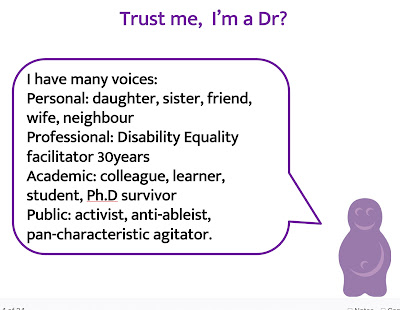
Trust me, I'm a Dr? I have many voices: Personal: daughter, sister, friend, wife, neighbour Professional: Disability Equality facilitator 30years Academic: colleague, learner, student, Ph.D survivor Public: activist, anti-ableist, pan-characteristic agitator.


I am sharing professional wisdom - that’s 30+ years of conversation.  Like discussions about critical race or gender, ones about critical disability is a specialised subject with an extensive knowledge base [you wouldn’t stop random individuals on the street as it could be potentially traumatising]


Othering emerged fast as an emotional tension in the room; talking about disability is uncomfortable because the ‘them’ and ‘us’ continuum becomes more visible when we talk about who’s in/out. I too get tongue-tied and stutter in the choice of ‘them’ and ‘us’. Should I identify as a disabled author, or am I writing as an equal scholar in a discipline I've studied for decades - leadership. I'd prefer to let people identify as Disabled or non-disabled, rather than assume ... get it wrong. 


Clearly, there’s more to it than what’s wrong with you… what about society? Where’s the difference, mobility, impairment, glasses, dyslexia?  The question is do you identify, surely? Do you face ableism? One in ten of us may choose, that's a huge group. 


Truth is terminology, or lack of it, hinders definition or clarity. A single word, disability, covers so many notions, it’s not surprising we struggle to find accuracy - let alone alignment or agreement.  Words fail when it comes to nuance: label, diagnosis, politics, difference, impairment, network, community - disability has been used willy-nilly and every which way. To define ableism, I have used ortho-toxic, a portemanteau term, to describe the violent ideas and assumptions imposed on the disabled population. It means I don’t have to point a finger - at individuals or groups - people can identify as they wish.  It’s clear it’s not always a reflection within easy reach, many will say they’ve never encountered sexism, for example, others say islamophobia appears the minute they cross their own doorstep. 


It is surprising how many of us can ignore the subject of disability altogether, while others see it as an aspect of human diversity, yet more will recoil in horror or embarrassment… how dare you bring your elephant to the room…  it’s hard to identify, as I explained, you run the risk of being dismissed [see Kafer on testimonial injustice].


Misrepresentation is evident in the textual world, where a noticeable silencing tells us that disabled people are untrustworthy.  Disabled people are not recognised as authors, thereby denied a voice in mainstream debates that impact them negatively. Rarely referred to as writers with authority, creators of knowledge, in documents that largely reinforce their marginalisation instead.


Why would I lie?

This shape of silence is hard to describe but essential to describe the framing of d/Disabled authors in text. Selective editing of 1st hand experience, giving a framed story with a medicalised view of the person as the problem. Denying the systemic, institutional and social violence reminiscent of #MeToo and #BLM campaigns. It seems the paid-pen exercises its privilege, not exclusively held by white, professional men, but under a more omnipresent cis/white/elitist gaze. Resistance is far harder for the pens held by those not fighting racism, classism, sexism, homophobia, religious intolerance or prejudice linked to partner and family choice. The 9 protected characteristics should be equitable categories, but cumulative impact is rarely articulated in guidance. If disability is mentioned on reference lists, details are shed, and divergent voices are erased, as unconsciously layers become shorter to save wordage in the final draft. Where disability may be ninth in a list in the introduction, sometimes mentioned in the review, it then disappears in discussion… as for the reference section watch the tumbleweed.  Of course, disabled writers may not identify for fear of having their texts judged harshly, and many write from 1st experience rather than with activism or accountability to other disciplines and professional journals. Disability in title rarely translates to existing knowledge, or knowers in the narrative. Assumptions and bias obvious in the individualising, personalising, uniqueness of condition or individual. This writes away the dimensions of institutional and systemic discrimination and societal disadvantage.


The impact of silencing is apparent where assumptions become myths reinforcing the stereotypes that themselves grow from ignorance - not experience or research evidence. The belief that a mere few need consideration, therefore the problem can be attributed to the unlucky or the undeserving. The omission in disciplinary and professional texts, forgotten in the granular, or believed to be the problem [cost] of another department, profession, or institution. The idea that there’s a line to be drawn between those who can and those who cannot fit into the system; the rules imposed keeping some watching from afar and others further yet beyond the walls. Finally, the dehumanising of those then viewed as public property; from research to the pool-side, experience is used, revised or demanded as it is considered both cheap and devoid of typical privacy - no consent or care required in the probing.


Accountability, or rather the legitimacy gap that is articulated here, denotes a breakdown of trust where reputation lacks any acknowledgement to the disabled population, disability equality or the interests of the disabled people’s movement [D/deaf and Disabled People’s Organisations].  Where legitimacy theory can be defined as the ability to respond to civil groups it will need to demonstrate an intent to address their interests fully in organisational accounts - and society’s storytelling. 


As Oswick et al. put forward, a radical travelling theory is one that moves beyond its own domain of production to be adopted by existing ones with equal measure. A theory that adopts anti-ableism in its intent, therefore, needs broad applicability [Social Model]; so that it can effectively begin ‘a process of repackaging, refining, and repositioning a discourse (or text) that circulates in a particular community for consumption within another community’ (2011, p. 323).


From the sadness at birth, testing for school, a poor practice that stigmatises, barriers, denigration and rejection in the workplace, made victims by justice and barred entry to transport, housing and leisure, the reduction of the human rights agenda applied to disabled people is reduced to care and cure, and adds massive cost to society. Plus, there's no price on the emotional burden imposed on many!


Trust me!

Just ‘any effort’ isn’t sufficient, the imperative behind practice needs to be with the right effort and have deliberate intentionality. While good, best and proactive practice sometimes equates, addressing ableism doesn’t happen by accident while chasing efficiency. Because being better at treating people fairly means recognising an agenda broader than financial value. Divisible or conditional human rights is a nonsense! Cutting down on worth and values, will not achieve more equitable culture(s). Practice will need to change to avoid the very activity that compounds the structural discrimination and the impact of inequality experienced by so many.  Addressing ableism is like tapping your head while rubbing your tummy, different actions are required at individual, team and organisational levels. 


Bibliography

Aikaterini Malli, M., Sams, L., Forrest, R., Murphy, G., & Henwood, M. (2018). Austerity and the lives of people with learning disabilities. A thematic synthesis of current literature. Disabiity & Society, 1412-1435 .

Anderson, T. (2017). Telling the story of disability. Retrieved 11 10, 2018, from Washington state university libraries: https://research.wsulibs.wsu.edu/xmlui/handle/2376/12238

Beauchamp-Pryor, K. (2012, 6 20). From absent to active voices: securing disability equality within higher education. International Journal of Inclusive Education, 16(3), 283-295.

Beresford, P. (2003). It's our lives, A short theory of Knowledge, Distance and Experience. London: Citizen Press / Shaping our lives.

Campbell, J., & Gillespie-Sells, K. (1991). Disability Equality Training: a trainers guide. London: CCETSW.

Chapman , L. M. (2013). A Different Perspective on Inclusive Practice Respectful Language . Huddersfield: EQTraining Publishing .

Chapman, L. M. (2016, feb 26). The words that bind us . Retrieved Aug 12, 2017, from The Language Of Respect : http://languageofrespect.blogspot.co.uk/2016/02/the-words-that-bind-us.html

Crow, L. (2014, 8 28). Scroungers and Superhumans: Images of Disability from the Summer of 2012: A Visual Inquiry. Journal of visual culture, 13(2), pp. 168-181.

Disability Rights UK. (2012). The Equality Act and disabled people. Retrieved 11 13, 2019, from Disability Rights UK: https://www.disabilityrightsuk.org/equality-act-and-disabled-people

Dolmage, J. T. (2017). Academic Ableism: Disability and Higher Education. San Francisco: University of Michigan Press.

Ellis, K., & Kent, M. (2016). Disability and Social Media: Global Perspectives [Kindle Edition]. abingdon: Routledge.

Equality and Human Rights Commission. (2016). Crime and disabled people: Measures of disability-related harassment 2016 update. Equality and Human Rights Commission. Equality and Human Rights Commission.

Fenney Salked, D. (2016). Sustainable lifestyles for all? Disability equality, sustainability and the limitations of current UK policy. Disability & Society, 447-464.

Frame Works. (2016). How to Talk About Disability and Human Rights. Frame Works. Washington: Frame Works.

Fricker, M. (2007). Epistemic Injustice: Power and the Ethics of Knowing. Oxford: Oxford university press.

Fullan, M. (2011). The Moral Imperative Realized. Thousand Oakes: Corwin sage.

Goodley, D. (2012). Disability Studies: An Interdisciplinary Introduction. London: SAGE Publications Ltd.

Hall, A. (2016). Literature and Disability (Literature and Contemporary Thought) [Kindle Edition]. Abingdon: Routledge.

Hawley, K. (2012). Trust: A Very Short Introduction (Very Short Introductions) kindle edition. Ashford: OUP Oxford; 1 edition .

Hughes, B. (2015, Sept 11). Disabled people as counterfeit citizens: the politics of resentment past and present'. Disability and Society, 14.

Hybels, R. C. (2017, 12 13). On Legitimacy, Legitimation, And Organizations: A Critical Review And Integrative Theoretical Model. Academy Of Management Proceedings, 1995(1).

Inclusion London. (2020). Disability hate crime . Retrieved 4 4, 2020, from https://www.inclusionlondon.org.uk/campaigns-and-policy/facts-and-information/hate-crime/

Kafer, A. (2013). Feminist, Queer, Crip. Indiana: Indiana University Press.

McRuer, R. (2006). Crip Theory: Cultural Signs of Queerness and Disability (Cultural Front) [Kindle Edition].New York : New York University Press.

Orton, J. D. (1997). From inductive to iterative grounded theory: Zipping the gap between process theory and process data . Scandinavian Journal of Management, 13(4), 419-438.

Oswick, C., Fleming, P., & Hanlon, G. (2011). From borrowing to blending: rethinking the processes of organizational theory building . Academy of Management Review, 318–337.

Papworth Trust. (2018, 5 5). Papworth Trust's Disability in the UK: Facts and Figures 2018. Retrieved 8 16, 2018, from Papworth Trust: https://www.actionduchenne.org/news/papworth-trusts-disability-in-the-uk-facts-and-figures-2018

Pennycock, A. (2010). Language as a Local Practice . Abingdon: Routledge.

Perry, D. M. (2016, 2 25). How “Inspiration Porn” Reporting Objectifies People With Disabilities. Retrieved 11 11, 2018, from Medium: https://medium.com/the-establishment/how-inspiration-porn-reporting-objectifies-people-with-disabilities-db30023e3d2b

Qa Research. (2017). ‘It’s broken her’ – Assessments for disability bene ts and mental health 3. Rethink Mental Illness. Rethink Mental Illness.

Sergiovanni, T. (1985). Landscapes, mindscapes, and reflective practice in supervision. Journal of curculum and seprevision, No 1.5-17 5.

Slorach, R. (2015). A Very Capitalist Condition: A History and Politics of Disability. London: Bloomsbury.

Smith, D. (2016). Disability in the United Kingdom. Papworth trust. Cambridge: Papworth trust.

Sommers, J. (2017, 8 22). Disabled People's Right To An Independent Life Being Eroded By Cuts, Equalities Commission Warns . Retrieved 11 29, 2017, from Huffington Post: http://m.huffpost.com/uk/entry/uk_599c473ce4b06a788a2bef3