Showing posts with label Equality. Show all posts

03 December 2025

International day of Disabled People


Celebrating Disabled People’s Creativity, Experience and Voices on the International Day of Disabled People


Pools and Prejudice: Death in the Shallows

On this International Day of Disabled People, there’s no better time to celebrate stories that challenge expectations, confront prejudice, and centre disabled lives with honesty and strength. That’s why I wrote Pools and Prejudice: Death in the Shallows— I hoped to balance tension, wit, and social commentary with rare precision.


If you’re looking for a book that will both grip you and make you think differently about the world, Pools and Prejudice: Death in the Shallows is exactly that. Today, we celebrate disabled creativity, disabled resilience, disabled truth-telling. 


I wanted the plot to shine a light on the realities of disabled people navigating a world that often refuses to see us clearly. 


The story follows Meg whose experiences of exclusion, institutional failure and everyday ableism are woven through a mystery that unfolds in and around a local swimming pool—a community space that becomes a microcosm of society’s attitudes towards disabled people.

I refused to soften the truth, and avoided speaking in metaphors or inspirational clichés. Instead, to give readers a narrative grounded in lived experience and disability equality: flawed systems, hidden hierarchies, the exhausting bureaucracy disabled people face, and the emotional resilience required simply to exist within them. And also hoped to capture the warmth, humour, friendship, and the small acts of solidarity that keep people going. 


Readers say: 


“Characters bring texture, complexity and humanity, each revealing different sides of disability, trust and belonging.

Pools and Prejudice is more than a mystery; it’s a challenge to look deeper—beneath the surface of institutions, beneath polite conversations, and beneath assumptions about what disabled lives should look like. It’s bold, unapologetic storytelling from a disabled writer who understands that representation is not a luxury but a necessity.”


On days like today, when the world pauses to recognise disabled people, their rights and their contributions, it reminds us why authentic stories matter. They expose injustice. They provoke conversation. They forge connection. And, importantly, they carve space for disabled people to be protagonists in their own narratives—complex, fierce, and fully realised.


Furthermore in order to respect Disabled People’s Identity and highlight Stereotypes, I was careful not to counter the negative stereotypes imposed on disabled people with equally toxic positive ones.


https://www.amazon.co.uk/dp/B0DLBHGBLX

07 March 2022

Breaking The Bias

With huge thanks to Emma, and the University of Birmingham alumni team [@BBSalumniUoB]!! Let’s break the bias together! 


"I have applied my research in the training room, as director of EQuality Training, delivering critical disability programmes to organisation seeking to tackle inequality strategically. They say working in a more anti-abelist way has had great impact on their recruitment, team conversation, and the additional skills they’ve been able to deploy in practice

Mind the box

Our minds need to deal with a huge amount of information on a daily basis, so it’s unsurprising that we tend to lump stuff together. The boxes we shove information into, the stereotyping, isn’t the problem! What creates bias is the lack of thought we give to this boxing and its impact on our feelings and the difficulty we have in retrieving stuff. We rarely question, for example, whether it was put away correctly in the first place. Our boxing system is neither nuanced nor sensitive, it does not matter whether ideas are good, bad, right or wrong, in they go largely unquestioned. It seems volume matters more than accuracy, if what we hear is loud enough, and what we see is noticeable enough, we lob it in. If we hear sexist, homophobic, and racist comments they end up in a box. We have boxes full of ‘em.  Indeed, confirmation bias will see us actively adding conspicuous anomalies to our boxes, rather than looking out for the positive contributions individuals and groups make to the world around us.


When we think too fast, we react to the box, rather than take time to reflect on what is inside it - what we’ve seen, heard or read. Our judgements are skewed when based on what is assumed, our reaction likely to be in tune with what we feel – not at odds with what we think, had we taken time to question these feelings.  


At the crossroads on Women’s Day

As a disabled woman, I can speak on how ableism and ableism intersect. I used to be quite baffled by how emphatically some have rejected my experience over the decades.

A colleague once asked for my address, when I got to West Yorkshire… "no" they said … I looked at them somewhat confused. A stream of justifications followed, explaining why they had assumed that ‘West’ was not a region and why they felt I was wrong. I had to remind them it was my address, therefore I was most likely to know if it was correct or not. It was an uncomfortable moment for us both but illustrates quite clearly how unconscious bias works to confirm prejudice. A prejudice that ordinarily was absent in the appreciation of my contribution until that moment of inattention. Prejudiced was the assumption, in the split-second reaction, influencing my colleague's choice between my truth and theirs [here mine was rejected, but maybe I would have accepted theirs had I not been so certain of my own address - positive prejudice].


I’ve experienced this sort of thing many times, and the more I notice it the more it infuriates me. While I understand how bias happens, it’s no less painful to hear someone not believing you. Furthermore, BECAUSE it’s unconscious, I am likely to rattle someone’s certainty when opposing their feelings. They may feel they are right, but would possibly agree that the ideas they hold may be wrong. So it is of little help to point out the reaction, without the stereotype it is based on - the stories that are rarely questioned. Which makes the bias, or unchallenged assumption, especially difficult to stop. Because engaging in the stereotypes, lurking in everyday myths, demands a willingness to become aware of how prejudice works, and the lack of awareness that drives it. How seemingly unremarkable ideas lead us to have beliefs that we do not articulate.


Language and culture 

Our language and our culture create our world, what we say and what we see, is the fabric on which we weave our own story. Language matters because what gets the most airtime becomes the most trusted story - in the bigger storytelling. The shortcuts we take, for example in office or technical terminology, often reinforce either negative or positive ideas, particularly where wording does not help convey the complexity beyond our focus. Largely we stop questioning the assumptions we encounter daily when we hear the same story time and time again. If an idea is at odds with our experience [West Yorkshire] it will be dismissed, in time the exceptional is ignored and alternative views may disappear from the conversation altogether. When stressed, embarrassed, tired, or pushed for time, we rely more on feeling. It is then that we are less able to hear alternative views. Sadly our feelings aren’t critical or nuanced, we are far more likely to react to the box than think about what’s in it. Unless we're careful, we stop questioning the dominant narrative: the sexism, racism, homophobia, classism, religious intolerance, and the rejection of family or personal choice, because it's just too unremarkable being around us every day.


Unfortunately, when the ideas about a group of people are largely negative, our thoughts and actions may alter. For example, if we hear often enough that widget makers are cranky, we might approach them with trepidation- without even realising why we’re acting differently.  To unlearn bias we will need to identify very mindfully that the assumption - cranky - is worth questioning to then think quite deliberately about its veracity. Are the widget makers I’ve met cranky? Is it likely that ALL widget makers are equally cranky? Is it more likely that among widget makers some may be cranky but on the whole no more than any other group? In addition, overall there are more differences between widget makers than those not making widgets. Have widget makers had bad press over the years? Could their actions also be a reaction to this bad PR!?


Questioning the assumption

The bias, regarding sexism and ableism, comes from what we’ve seen and heard about disabled women over the years. Silence, or negative ideas, may have led to a list of unarticulated beliefs that sway our judgment, and while the ideas we boxed unquestionably may seem incongruous when exposed, it’s likely we react to them without thinking. Gladwell suggests we react so fast, in the blink of an eye, that our excuse is built on reaction rather than the assumption. the bias, then, is reinforced by thinking, rather than the idea exposed for myth. In this cycle, while evidence may be ignored, experience sits at odds with wider understanding becoming less important than our experience.  


While we ignore the impact of stereotypes on our actions, we’ll also unwittingly seek to confirm our bias, by not noticing the negative implications of our poor practice. Those in receipt of prejudice tend to react, rather than flourish, in an internal struggle against the discrimination they encounter. Energy directed in defence will be unavailable for advance. 


Breaking good

 Being nice does not break bias, particularly when it reinforces an otherwise unarticulated belief that some women are needy or deserving of pity. Exposing the myths is more important, a good spring clean of what we've boxed. Disabled women are no needier or wanting of pity. Exposing the negative ideas, those we see all too often when we search for them, and encourages us to identify the sexist/ablist assumptions behind so many storylines. Courageous, vile, uneducated, stupid, unfeeling - the many characterisations of cranky - imposed on groups and individuals.  


Breaking bias calls on us to replace complacency with action. To notice the assumptions, if not in the moment, soon after it! By asking "why did I feel I had to question and correct Joanna Jones?"  Reflection in action may be better still "before I interrupt Joanna, I better trust Ms Jones, and stop myself from interrupting or correcting her". Better still is to look for the harmful impact of many assumptions, hold them up for scrutiny, and think about the unintended consequences of what we say.  Thinking about Joanna Jones’s experience having to negotiate sexism and ableism, and understanding her success in breaking expectations- an achievement that needs to be evident. Most probably proof of her tenacity - not a fancy tale about her failure.


Reflection for action [rather than -in or -on action]  in its pre-emptive nature may be the best solution to breaking the bias. Not a quick fix, given the amount of homework needed to explore the alternatives, but certainly a route to shedding a light on the negative attitudes we are led by when we are not full of care. As we are called to think slow, rather than quick, let’s be willing to take a little time for the effort to appreciate the strength and knowledge in others with the sensitivity we owe them.


Bibliography

Agar, M. (1994). Language Shock: Understanding the Culture of Conversation. New York: Harper Collins.

Anderson, T. (2017). Telling the story of disability. Retrieved 11 10, 2018, from Washington state university libraries: https://research.wsulibs.wsu.edu/xmlui/handle/2376/12238

Berghs, M., Atkin, K., Graham, H., Hatton, C., & Thomas, C. (2017, 6 24). Public health, research and rights: the perspectives of deliberation panels with politically and socially active disabled people. Disability & Society, pp. 945-965.

Bryant, Watson, & Philo. (2011). Bad News for Disabled People: How the newspapers are reporting disability. University of Glasgow, Inclusion London. Glasgow: Strathclyde Centre for Disability Research and Glasgow Media Uni.

Burch, L. (2018). ‘You are a parasite on the productive classes: online disablist hate speech in austere time'. Disability and Society, 33(3), pp. 392-415.

Coleman, J., Brunell, A., & Hauge, I. (2014). Multiple Forms of Prejudice: How Gender and Disability Stereotypes Influence Judgments of Disabled Women and Men. Science+Business Media, 34, 177–189.

Crow, L. (2014, 8 28). Scroungers and Superhumans: Images of Disability from the Summer of 2012: A Visual Inquiry. Journal of visual culture, 13(2), pp. 168-181.

Deal, M. (2007). Aversive disablism: subtle prejudice toward disabled people. Disability & Society, 22(1).

Gladwell, M. (2008). Blink - The Power of Thinking Without Thinking. London: Penguin Books.

Hughes, B. (2015, Sept 11). 'Disabled people as counterfeit citizens: the politics of resentment past and present'. Disability and Society, 14.

Kahneman, D. (2011). Thinking, Fast and Slow. London: Penguin.

Shohamy, E. (2006). Language Policy: Hidden agendas and new approaches. Abingdon: Routledge.


19 February 2022

Trust me, why would I lie!?

My thanks to Touch Consulting, and the Joy FE community, who makes the #FestivalFridays conversations possible. A learning network of courageous practitioners who are resistance to the established norms that can hinder the well-being of those struggling to flourish within education.


I enjoy the enthusiasm in the lead up to a presentation, there’s an energy that comes of being wanted. A thrill, and anxiety, that is motivating and exhausting in equal measure… I’m no longer surprised that the linear story I have in my head, put into text with supporting 34 snapshots, rarely ever matches the messiness of the conversation in the room. Years of keynotes do not compare well to the joyful chaos of building understanding in the room.


I started with a trigger warning, not because it’s fashionable, but because we know that 9 in 10 disabled people report hate crime every year.  Therefore, we can assume that violence is recognised in most rooms, because one in ten individuals can identify as disabled- should they wish. I explained that while the story was mine, we were having a professional dialogue, so the storytelling was framed by evidence and theory [Disability Studies among others]. 


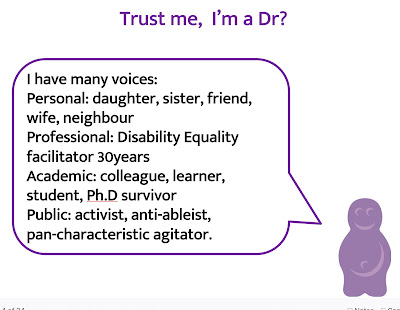
Trust me, I'm a Dr? I have many voices: Personal: daughter, sister, friend, wife, neighbour Professional: Disability Equality facilitator 30years Academic: colleague, learner, student, Ph.D survivor Public: activist, anti-ableist, pan-characteristic agitator.


I am sharing professional wisdom - that’s 30+ years of conversation.  Like discussions about critical race or gender, ones about critical disability is a specialised subject with an extensive knowledge base [you wouldn’t stop random individuals on the street as it could be potentially traumatising]. 


Othering emerged fast as an emotional tension in the room; talking about disability is uncomfortable because the ‘them’ and ‘us’ continuum becomes more visible when we talk about who’s in/out. I too get tongue-tied and stutter in the choice of ‘them’ and ‘us’. Should I identify as a disabled author, or am I writing as an equal scholar in a discipline I've studied for decades - leadership. I'd prefer to let people identify as Disabled or non-disabled, rather than assume ... get it wrong. 


Clearly, there’s more to it than what’s wrong with you… what about society? Where’s the difference, mobility, impairment, glasses, dyslexia?  The question is do you identify, surely? Do you face ableism? One in ten of us may choose, that's a huge group. 


Truth is terminology, or lack of it, hinders definition or clarity. A single word, disability, covers so many notions, it’s not surprising we struggle to find accuracy - let alone alignment or agreement.  Words fail when it comes to nuance: label, diagnosis, politics, difference, impairment, network, community - disability has been used willy-nilly and every which way. To define ableism, I have used ortho-toxic, a portemanteau term, to describe the violent ideas and assumptions imposed on the disabled population. It means I don’t have to point a finger - at individuals or groups - people can identify as they wish.  It’s clear it’s not always a reflection within easy reach, many will say they’ve never encountered sexism, for example, others say islamophobia appears the minute they cross their own doorstep. 


It is surprising how many of us can ignore the subject of disability altogether, while others see it as an aspect of human diversity, yet more will recoil in horror or embarrassment… how dare you bring your elephant to the room…  it’s hard to identify, as I explained, you run the risk of being dismissed [see Kafer on testimonial injustice].


Misrepresentation is evident in the textual world, where a noticeable silencing tells us that disabled people are untrustworthy.  Disabled people are not recognised as authors, thereby denied a voice in mainstream debates that impact them negatively. Rarely referred to as writers with authority, creators of knowledge, in documents that largely reinforce their marginalisation instead.


Why would I lie?

This shape of silence is hard to describe but essential to describe the framing of d/Disabled authors in text. Selective editing of 1st hand experience, giving a framed story with a medicalised view of the person as the problem. Denying the systemic, institutional and social violence reminiscent of #MeToo and #BLM campaigns. It seems the paid-pen exercises its privilege, not exclusively held by white, professional men, but under a more omnipresent cis/white/elitist gaze. Resistance is far harder for the pens held by those not fighting racism, classism, sexism, homophobia, religious intolerance or prejudice linked to partner and family choice. The 9 protected characteristics should be equitable categories, but cumulative impact is rarely articulated in guidance. If disability is mentioned on reference lists, details are shed, and divergent voices are erased, as unconsciously layers become shorter to save wordage in the final draft. Where disability may be ninth in a list in the introduction, sometimes mentioned in the review, it then disappears in discussion… as for the reference section watch the tumbleweed.  Of course, disabled writers may not identify for fear of having their texts judged harshly, and many write from 1st experience rather than with activism or accountability to other disciplines and professional journals. Disability in title rarely translates to existing knowledge, or knowers in the narrative. Assumptions and bias obvious in the individualising, personalising, uniqueness of condition or individual. This writes away the dimensions of institutional and systemic discrimination and societal disadvantage.


The impact of silencing is apparent where assumptions become myths reinforcing the stereotypes that themselves grow from ignorance - not experience or research evidence. The belief that a mere few need consideration, therefore the problem can be attributed to the unlucky or the undeserving. The omission in disciplinary and professional texts, forgotten in the granular, or believed to be the problem [cost] of another department, profession, or institution. The idea that there’s a line to be drawn between those who can and those who cannot fit into the system; the rules imposed keeping some watching from afar and others further yet beyond the walls. Finally, the dehumanising of those then viewed as public property; from research to the pool-side, experience is used, revised or demanded as it is considered both cheap and devoid of typical privacy - no consent or care required in the probing.


Accountability, or rather the legitimacy gap that is articulated here, denotes a breakdown of trust where reputation lacks any acknowledgement to the disabled population, disability equality or the interests of the disabled people’s movement [D/deaf and Disabled People’s Organisations].  Where legitimacy theory can be defined as the ability to respond to civil groups it will need to demonstrate an intent to address their interests fully in organisational accounts - and society’s storytelling. 


As Oswick et al. put forward, a radical travelling theory is one that moves beyond its own domain of production to be adopted by existing ones with equal measure. A theory that adopts anti-ableism in its intent, therefore, needs broad applicability [Social Model]; so that it can effectively begin ‘a process of repackaging, refining, and repositioning a discourse (or text) that circulates in a particular community for consumption within another community’ (2011, p. 323).


From the sadness at birth, testing for school, a poor practice that stigmatises, barriers, denigration and rejection in the workplace, made victims by justice and barred entry to transport, housing and leisure, the reduction of the human rights agenda applied to disabled people is reduced to care and cure, and adds massive cost to society. Plus, there's no price on the emotional burden imposed on many!


Trust me!

Just ‘any effort’ isn’t sufficient, the imperative behind practice needs to be with the right effort and have deliberate intentionality. While good, best and proactive practice sometimes equates, addressing ableism doesn’t happen by accident while chasing efficiency. Because being better at treating people fairly means recognising an agenda broader than financial value. Divisible or conditional human rights is a nonsense! Cutting down on worth and values, will not achieve more equitable culture(s). Practice will need to change to avoid the very activity that compounds the structural discrimination and the impact of inequality experienced by so many.  Addressing ableism is like tapping your head while rubbing your tummy, different actions are required at individual, team and organisational levels. 


Bibliography

Aikaterini Malli, M., Sams, L., Forrest, R., Murphy, G., & Henwood, M. (2018). Austerity and the lives of people with learning disabilities. A thematic synthesis of current literature. Disabiity & Society, 1412-1435 .

Anderson, T. (2017). Telling the story of disability. Retrieved 11 10, 2018, from Washington state university libraries: https://research.wsulibs.wsu.edu/xmlui/handle/2376/12238

Beauchamp-Pryor, K. (2012, 6 20). From absent to active voices: securing disability equality within higher education. International Journal of Inclusive Education, 16(3), 283-295.

Beresford, P. (2003). It's our lives, A short theory of Knowledge, Distance and Experience. London: Citizen Press / Shaping our lives.

Campbell, J., & Gillespie-Sells, K. (1991). Disability Equality Training: a trainers guide. London: CCETSW.

Chapman , L. M. (2013). A Different Perspective on Inclusive Practice Respectful Language . Huddersfield: EQTraining Publishing .

Chapman, L. M. (2016, feb 26). The words that bind us . Retrieved Aug 12, 2017, from The Language Of Respect : http://languageofrespect.blogspot.co.uk/2016/02/the-words-that-bind-us.html

Crow, L. (2014, 8 28). Scroungers and Superhumans: Images of Disability from the Summer of 2012: A Visual Inquiry. Journal of visual culture, 13(2), pp. 168-181.

Disability Rights UK. (2012). The Equality Act and disabled people. Retrieved 11 13, 2019, from Disability Rights UK: https://www.disabilityrightsuk.org/equality-act-and-disabled-people

Dolmage, J. T. (2017). Academic Ableism: Disability and Higher Education. San Francisco: University of Michigan Press.

Ellis, K., & Kent, M. (2016). Disability and Social Media: Global Perspectives [Kindle Edition]. abingdon: Routledge.

Equality and Human Rights Commission. (2016). Crime and disabled people: Measures of disability-related harassment 2016 update. Equality and Human Rights Commission. Equality and Human Rights Commission.

Fenney Salked, D. (2016). Sustainable lifestyles for all? Disability equality, sustainability and the limitations of current UK policy. Disability & Society, 447-464.

Frame Works. (2016). How to Talk About Disability and Human Rights. Frame Works. Washington: Frame Works.

Fricker, M. (2007). Epistemic Injustice: Power and the Ethics of Knowing. Oxford: Oxford university press.

Fullan, M. (2011). The Moral Imperative Realized. Thousand Oakes: Corwin sage.

Goodley, D. (2012). Disability Studies: An Interdisciplinary Introduction. London: SAGE Publications Ltd.

Hall, A. (2016). Literature and Disability (Literature and Contemporary Thought) [Kindle Edition]. Abingdon: Routledge.

Hawley, K. (2012). Trust: A Very Short Introduction (Very Short Introductions) kindle edition. Ashford: OUP Oxford; 1 edition .

Hughes, B. (2015, Sept 11). Disabled people as counterfeit citizens: the politics of resentment past and present'. Disability and Society, 14.

Hybels, R. C. (2017, 12 13). On Legitimacy, Legitimation, And Organizations: A Critical Review And Integrative Theoretical Model. Academy Of Management Proceedings, 1995(1).

Inclusion London. (2020). Disability hate crime . Retrieved 4 4, 2020, from https://www.inclusionlondon.org.uk/campaigns-and-policy/facts-and-information/hate-crime/

Kafer, A. (2013). Feminist, Queer, Crip. Indiana: Indiana University Press.

McRuer, R. (2006). Crip Theory: Cultural Signs of Queerness and Disability (Cultural Front) [Kindle Edition].New York : New York University Press.

Orton, J. D. (1997). From inductive to iterative grounded theory: Zipping the gap between process theory and process data . Scandinavian Journal of Management, 13(4), 419-438.

Oswick, C., Fleming, P., & Hanlon, G. (2011). From borrowing to blending: rethinking the processes of organizational theory building . Academy of Management Review, 318–337.

Papworth Trust. (2018, 5 5). Papworth Trust's Disability in the UK: Facts and Figures 2018. Retrieved 8 16, 2018, from Papworth Trust: https://www.actionduchenne.org/news/papworth-trusts-disability-in-the-uk-facts-and-figures-2018

Pennycock, A. (2010). Language as a Local Practice . Abingdon: Routledge.

Perry, D. M. (2016, 2 25). How “Inspiration Porn” Reporting Objectifies People With Disabilities. Retrieved 11 11, 2018, from Medium: https://medium.com/the-establishment/how-inspiration-porn-reporting-objectifies-people-with-disabilities-db30023e3d2b

Qa Research. (2017). ‘It’s broken her’ – Assessments for disability bene ts and mental health 3. Rethink Mental Illness. Rethink Mental Illness.

Sergiovanni, T. (1985). Landscapes, mindscapes, and reflective practice in supervision. Journal of curculum and seprevision, No 1.5-17 5.

Slorach, R. (2015). A Very Capitalist Condition: A History and Politics of Disability. London: Bloomsbury.

Smith, D. (2016). Disability in the United Kingdom. Papworth trust. Cambridge: Papworth trust.

Sommers, J. (2017, 8 22). Disabled People's Right To An Independent Life Being Eroded By Cuts, Equalities Commission Warns . Retrieved 11 29, 2017, from Huffington Post: http://m.huffpost.com/uk/entry/uk_599c473ce4b06a788a2bef3


23 November 2021

Trust

Shattered!


I remember years ago working for the Work Foundation, on the Commissioner’s Leadership Programme. I was listening to the gentleman speaking before me talk about trust. He said that trust once broken, was like a dropped plate, once shattered it was fragile and rarely the same again. This troubled me, I’d like to think that over time trust can be rebuilt, and that conversations within relationships can help us feel safe once more. 


Roll on a few years, another conference, another speaker, and I hear that trust cannot be demanded. "You can’t send a memo on Friday night asking for more trust on Monday morning.” Indeed, I’d have to say that the words ‘trust me’ tend to solicit an opposite reaction in me. It is up there in the red flag department with ‘I’ve worked with someone like you before’ and ‘we’re inclusive’. The most reflective among us will say ‘I trust you’ rather than ‘trust me’ when seeking to establish safety in an exchange.  Invariably it’s not a hiccup, but a big crash when trust breaks down, and things fall apart.


Photo of a woman reflected in  broken glass


I have been accused by DM of hating men and non-disabled people. Both are untrue as far as I can trust myself, but I do indeed rant against the sexism and ableism I experience. These DMs typically arrive shortly after I have highlighted the fear, pain, and harm caused by ignorance, injustice and disadvantage. More specifically when I’ve called out poor practice. My tone is no doubt angry, as these are situations where I am calling on others to understand the cost of discrimination – the huge emotional labour of fighting for safe space. It’s very easy to say I should trust people to be kind, but without having been able to take it for granted doing so is very difficult. Several times this past year I’ve been treated unfairly. So it’s not that I don’t want to trust the next person, it’s that I did trust the last, and the few before that, and they dropped the plate… they refused to hear what I needed to say to be able to work without fear. Furthermore, in one case I asked for help, reasonable adjustments were agreed but later refused because I was too stupid to understand what inclusion meant. I was left shattered, shamed and humiliated. 


So baring scars I’ve asked to be heard, and it’s a game-changer! Starting a new job recently, my now colleague, asked what I needed before work went ahead. After a five minute conversation, we agreed that the difficulties I listed weren’t deal-breakers. I also felt happier, as the probable extra effort to come had been acknowledged. As it happened help wasn’t necessary, but I knew that if problems should occur I would be allowed to speak before they became catastrophic. More importantly, I felt trusted, therefore no longer fearful that I would be penalised for not having voiced my weaknesses.  I took this learning to my next job… 


Whether you agree with disability equality is not the key here, it’s whether you can work in ways that express it. Without that commitment, I can’t rely on practice that doesn't counter your organisation’s ableism. Therefore I will continue to find it hard to trust without dialogue. I will need a few minutes to hear in your voice or see in your face, that you understand the position I face. Because, without you acknowledging my fears, you will not able to address them.


The point of this bletther is to move away from woe-me. I understand that the current circumstances have put pressure on us all. But I’ve been left ashamed and shattered far more than once this year!  To trust again will require dialogue. I am no more vulnerable than anyone else, but fragile I am, from repeatedly being shut down when I needed my fears heard. Fears that have grown over the years, ignored or dismissed, so that now the tiniest of pressures can make me crack. The fissures may not be of your making, but as my new colleagues have shown trust can be rekindled. Thank you Lucy and Kevin for always asking!  

04 June 2021

Ableism ?!

The word ‘ableism’ has gained much currency these past few years. I have noticed the hashtag increasingly being used by the disabled community across social media. Yet, it has no doubt remained a mystery to many. But for Disabled people, the activists among us, it has become hugely significant, as it represents a parity to sexism, classism, homophobia, racism, religious intolerance… words used daily to denote the organisational, institutional and structural injustice many individuals from marginalised groups face.


A working definition:

Without a definition, there is no way of identifying the characteristic discrimination imposed on disabled people. If we don't speak about ableism, it doesn't exist, because it is not something we give time to - or that we acknowledge. I work to two definitions based on what I’ve read:

Ableism: a specific type of oppression, akin to homophobia, racism, classism, ageism, and sexism, held in the culture and language that inform society’s debates.

Anti-ableist: a defined position against ableism, the characteristic oppression that disabled people face - as in feminist or anti-racist.  Theorising, for example, with an anti-ableist legitimacy involves explicit reference to disabled people as tellers in a storytelling that holds their interests at their heart.


I work as an anti-ableist, which means in seek in my practice, and my writing, to articulate an opposition to the ableism in the world around me. Notwithstanding the experience of individuals, and while allowing them choices of identity, I act to disrupt the institutional and societal narratives that perpetuate ableism. Disabled authors have gone to great efforts to define their experience, by doing so they encourage us to focus on the injustice they face.  Moving beyond issues of identity is critical, because while the predicament of impairment or difference and personal prejudice is significant, but it does not go far enough to explain the startling figures that characterise the inequality the disabled population face. Yet it is an inequality many cannot put a word to, despite its toxicity and omnipresence, the storytelling that surrounds us is ableist.


In the same way that critical race theory has given us a language to articulate the structural racism people face, critical disability theory has led to a growing terminology for the societal discrimination imposed on disabled people as a marginalised group. As a specific, insidiously hidden discrimination, ableism has a unique character. The idea that disability sits on a continuum at the opposite end to ability is to misunderstand the meaning of the marginalisation imposed on disabled individuals. If there is an opposite, it isn’t perfection, skill or ability, but a lack of privilege - the possibility of living without being viewed as a problem. It is the notion of ‘able’ as the norm that defines the unearned privilege afforded to those who do not need to answer questions about their difference. Beyond individual experience, ableism is held in conversations at group, department, organisational, local and national levels. Each holds a distinct way of silencing, or distorting, the voice of disabled people by denying their experience, domesticating their ideas, appropriating their knowledge or refusing to theorise by including divergent ideas.


It is not so much that people go out of their way to speak badly of disabled individuals, it is more so that we’ve become accustomed to believing the tales we hear about them. Therefore, disabled authors are less frequently referred to as trusted and truthful storytellers. More often found in specialist literature, their accounts are often absent from organisational, institutional and public debates. Furthermore, in the media, disabled people are often described as saints and sinners that laud or vilify their individual stories. It is in the globe-local storytelling that the voice of disabled people is erased. Furthermore, we’ve forgotten to question why. When written into guidance, policy and strategy, the assumptions derived from the saint/sinner stereotype become apparent, not as a caricature so much as forgotten altogether. That’s to say most will forget to think of disabled people as a sizeable population entitled to parity rather than the isolated individual needing to get off their backside – because the saints are doing it so valiantly. Ableism is not written into organisational accounts, however, documents such as audits, reviews, external communications, and annual reports generally fail to name the negative impact of the business on the disabled population. Thus textual worlds fail to articulate an opposition to the institutional disablism within a sector or the ableism in society more widely. Therefore, failing to acknowledge the contribution to human rights erosion imposed by growing inequality, and the lack of measures to gauge it, while attention is focused on what makes money.


A cycle of misrepresentation 

How does a gap in legitimacy grow between organisational accounts and the voice of D/deaf and Disabled People’s Organisations?  Why is there an absence of measures calculating prejudice, disablism and ableism? A lack of response-ability towards the disabled population. 


A vicious circle: 


Stereotypes lead to assumptions which lead to feelings and behaviour in a cycle that perpetuates ableism


As the diagram above illustrates, a cycle is perpetuated in conversations where the speaker reacts to what they have heard about disabled people [prejudice], rather than question the storytelling that misrepresents them. In the assumption that what the speaker has read or heard is correct, many will repeat largely exaggerated ideas, rather than stand against the ableism within the account. In society's storytelling, where the voices of disabled people are missing, their interests are often replaced by problems based on assumption -  rather than disabled people's experience or research evidence. In turn, these unchallenged beliefs left unquestioned drive negative attitudes. In this cycle, ableism often goes unnoticed, hidden in words, phrasing or sayings that seem innocuous but no doubt harm. This harm will be reacted to more or less subconsciously, with feelings and reactions in individuals who may also internalise ideas about themselves - the stereotypes. 


Often the gap between what we believe and what we think is so great, that it is hard to think ourselves out of a stereotypes by changing the words use or the actions we take.  


How do we interrupt this cycle?

Each arrow calls us to stop and think in order to change things in different ways.

SMALL PURPLE ARROW 

Spot the stereotype: there’s no easy solution, foremost we need to be willing to learn from disabled individual's experience, knowledge and professional wisdom. That's disabled authors as storytellers: activists, professionals, academics, and D/deaf and Disabled People’s Organisations. Personal accounts will vary, and no disabled individual owes another a story. There are forests of information [books, websites, videos, podcasts…] take it steady. I suggest short introductory texts, preferably with a degree of rigour, based on evidence, because while unique perspectives can be made to fit a dominant narrative [ableist], getting the framing right alters the narrative.


Small red arrow


Challenge assumption: Reflection isn’t easy, but time taken to think about immediate re-action, to determine why we act / think certain ways, may interrupt a bias we aren’t aware of.  The pervasive, often innocuous, nature of stereotypes in our conversations and across media, means there is lots to unlearn…. Literally unthinking the unthinkable is a job in itself. Disabled or not we owe it to those around us to figure out the lies and the myths that perpetuate negative ideas in storytelling. 


Small green arrow


Consider the tellers: try to understand stories from an alternative perspective, placing disabled authors as the pen-holders. In most everyday conversation, the tales we tell, the unchallenged storytelling, erases the experience, knowledge and wisdom of disabled people. Sometimes in ways even they cannot put into words. The more you hear you’re rubbish, worthless, weak, wrong, pitiable… the more you believe it. The more you feel rejected, the more you fight or give up. No two disabled individuals will have the same feelings. [heavens, my feelings change every hour on the hour]. I’m always grateful when people interrupt my learned thinking. 


Small blue arrow


Understand communication: behaviour that confounds you may indeed be a challenge to be more empathetic. Are disabled people responsible for stereotypes, or have we led them to act in response to a single choice between saint or sinner?  No one can answer this without first trying to understand the internalised ableism may lead individuals to do things that mistily those around them. Hushing the voice that says you’re rubbish, work harder, prove ‘em wrong, show strength, hide vulnerability, is not only difficult but hugely exhausting. 


Be disability specific – anti-ablism 

D/deaf and Disabled People’s Organisations present an authentic source of the population’s interests in a way that unites a multitude of voices on a joint vision. Activism is a more complex notion than choice of identity and personal experience, as it draws on evidence and knowledge which can also subject to ableism. It certainly is a way of avoiding the problems often attributed to disabled people as a group. 


Human rights and movement interests: 


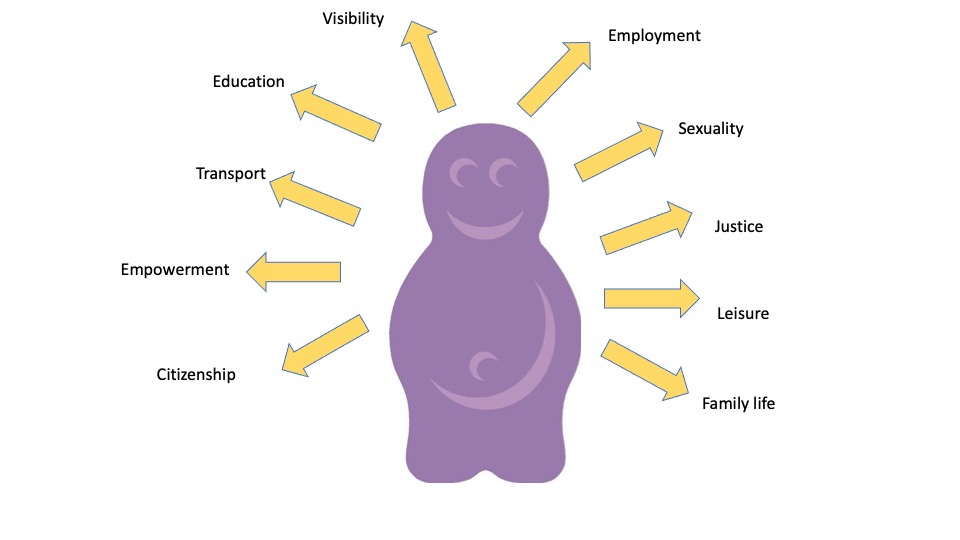
The human rights of the disabled population as stated by DDPOs include education, transport, employment, housing,  justice, leisure, family and community life


For professionals willing to address this matter, Disability Equality is a subject area based on disability studies that provides a good entry point. No doubt due to the barriers faced by disabled individuals, and the lack of recognition the Disabled people’s movement receives as an equivalent voice within civil rights groups. There were no words framing ableism until recently, akin to feminism, sexism, homophobia, or white privilege. Despite an era of rising social awareness, the institutional and societal injustice specific to disability had no name, no voice, and little more than a network of grassroot organisations with an oral history.


Bibliography

Ahmed, S. (2017). Living a Feminist Life [Kindle Edition] . Duke University Press.

Aspie, S. (2018, 8 2). Read ALLFIE campaigner Simone’s “barnstorming” speech to the Global Disability Summit. Retrieved 8 22, 2018, from The Allaince for Inclusive Education: https://www.allfie.org.uk/news/blog/read-allfie-campaigner-simones-barnstorming-speech-global-disability-summit/

Bebbington, J. (2011). Sustainable Development: A Review of the International Development, Business and Accounting Literature. Univ of Aberdeen Acct, Finance & Mgmt Working Paper No. 00-17 .

Brown, & Leigh. (2018). Ableism in academia: where are the disabled and ill academics? Disability & Society, 33(6), 985-989.

Deegan, C., & Unerman, J. (2011). Financial Accounting Theory: European Edition (UK Higher Education Business Accounting). MaidenHead: McGraw-Hill Education.

Equality and Human Rights Commission. (2018). How is the UK performing on disability rights? The UN’s recommendations for the UK. Equality and Human Rights Commission. EHRC.

Equality and Human Rights Commission. (2018). Progress on disability rights in the United Kingdom. Equality and Human Rights Commission, Equality Commission for Northern Ireland, Northern Ireland Human Rights Commission, Scottish Human Rights Commission. Equality and Human Rights Commission,.

Equality and Human Rights Commission. (April 2017). Being disabled in Britain - A journey less equal. Equality and Human Rights Commission. London: Equality and Human Rights Commission.

Fricker, M. (2007). Epistemic Injustice: Power and the Ethics of Knowing. Oxford: Oxford university press.

Goodley, D. (2014). Dis/ability Studies: Theorising disablism and ableism. London: Routlege.

Kumari Campbell, F. (2009). Contours of Ableism: The Production of Disability and Abledness. London: Palgrave Macmillan.

Kumari Campbell, F. (2019, 5). Precision ableism: a studies in ableism approach to developing histories of disability and abledment. The Journal of Theory and Practice, pp. 1-19.

McPhail, K., & Walters, D. (2009). Accounting & Business Ethics. Routledge.

Nind, M., Sheehy, K., & Simmons, K. (2003). Inclusive Education: Learners and Learnng Contexts. London: David Fulton.

Pease, B. (2013). Undoing Privilege, unearned advantage in a divided world. London, New York: Zed Books.

Slorach, R. (2016). A Very Capitalist Condition: A History and Politics of Disability [Kindle Edition]. London: Bookmarks.